
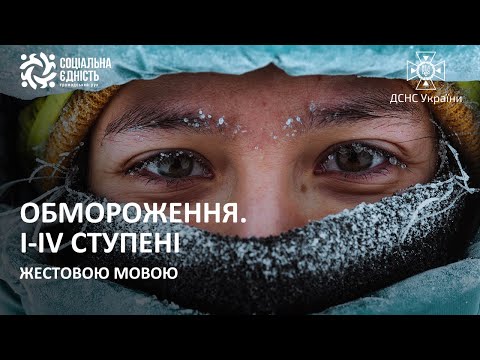
Every year, medical facilities in Ukraine receive patients with various stages of frostbite. According to medical observations, the number of such patients increases several times during periods of sudden cold spells. To avoid hypothermia and frostbite, experts recommend learning more about this and following the basic rules of conduct in low temperatures.
What is frostbite?
Frostbite is damage to any part of the body (including tissue death) caused by exposure to low ambient temperatures. Frostbite most often occurs at air temperatures below –10°C to –20°C. During prolonged exposure to the open air, especially in conditions of high humidity and strong winds, frostbite can occur in autumn and spring at air temperatures above zero. Statistics show that even all severe frostbite cases involving limb amputation occur when a person is in a state of severe alcohol intoxication.
Degrees of frostbite
First-degree frostbite (the mildest case) most often occurs when the human body is exposed to low temperatures for a short period of time. The affected area of skin is pale, turns red after warming up, in some cases has a dark red tint, and swelling begins to develop. There is no skin necrosis. At the end of the week after frostbite, slight peeling of the skin may begin. Complete recovery occurs on the 5th-7th day after frostbite. The first signs of such frostbite are a burning sensation, tingling, followed by numbness in the affected area of the body. This is followed by itching of the skin and slight or severe pain.
Second-degree frostbite occurs with prolonged exposure to cold. In the initial stage, paleness, cooling, and loss of sensitivity occur in the affected area, but these symptoms occur in all degrees of frostbite. Therefore, the most characteristic sign of second-degree injury is the appearance of blisters filled with clear fluid in the first few days after frostbite. Complete skin recovery occurs within 1-2 weeks without granulation or scarring. With second-degree frostbite, pain occurs after rewarming, which is more intense and prolonged than with first-degree injury. Itching and burning of the skin occur.
With third-degree frostbite, the duration of exposure to cold and the decrease in temperature of the affected area of the human body increases. The blisters that appear in the initial stage are filled with bloody fluid, their base is purple-red in color and insensitive to touch. All skin elements die off, and after recovery, granulations and scars appear in these areas. Affected nails do not grow back or grow back deformed. The rejection of dead tissue ends in 2-3 weeks, after which scarring begins, which lasts up to one month. The intensity and duration of pain is more pronounced than with second-degree frostbite.
Frostbite of the fourth degree occurs with prolonged exposure to cold, with the greatest decrease in temperature in the affected areas of the body. It is often combined with frostbite of the third and second degrees. All layers of soft tissue die, and bones and joints are often affected. The affected area of the body is dark blue in color, sometimes with a marbled pattern. Swelling occurs immediately after rewarming and increases rapidly. The temperature of the affected area of skin is significantly lower than on adjacent parts of the body. Blisters appear on less affected areas where third- and second-degree frostbite has occurred. The absence of blisters with rapid and widespread swelling and lack of sensitivity indicate the presence of fourth-degree frostbite. During prolonged exposure to low temperatures, not only local damage to parts of the body occurs, but also general cooling of the body. General cooling is understood as a condition that occurs when the body temperature drops below 34°C.


