On March 3, the global community celebrates World Hearing Day. For many years, the focus of this day has been on prevention and medical approaches. Starting this year, the theme "A Different Perspective" opens up a new direction—protecting the rights of sign language users.
"Sign language rights are human rights." This day is a wonderful opportunity to remind the government and the public what it means to be deaf in today's society.
The non-governmental organization "Public Movement "Social Unity" supports the World Federation of the Deaf's awareness campaign, and we want to delve deeper into the following important aspects:
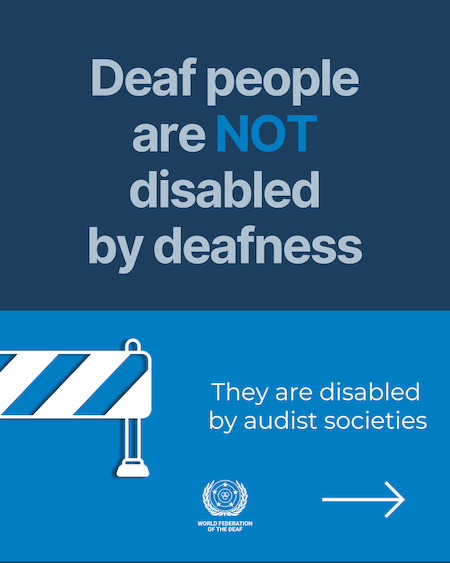
The problem is not with the person – the problem is with the system
Society is accustomed to viewing deafness solely as a medical diagnosis that needs to be corrected. However, in reality, deaf people face difficulties not because they cannot hear, but because their environment, education, healthcare, and information space are not designed with their needs in mind. This is audism—a systemic bias that still permeates many areas of our lives.
Sign language is not an auxiliary tool, it is a full-fledged Language
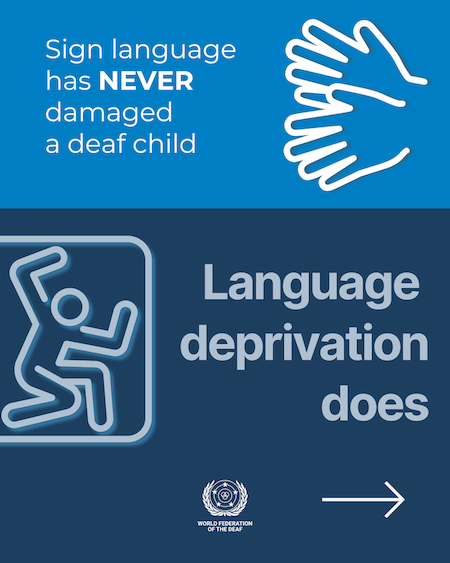
When a deaf child has the opportunity to communicate in their native language from an early age, they are able to learn fully, form their own identity, and feel part of society.
It is precisely the lack of access to sign language from early childhood that leads to language deprivation — a condition that truly harms a child's cognitive and social development.
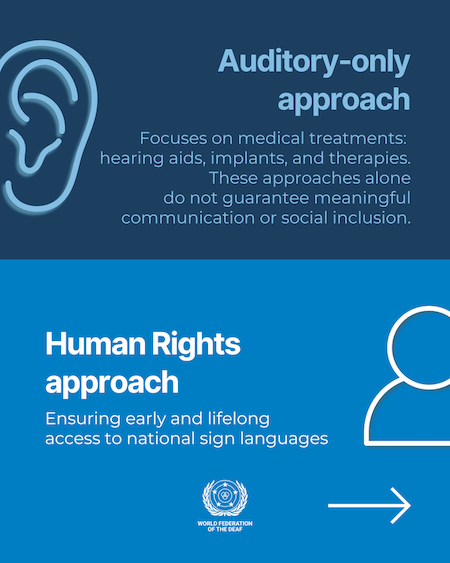
From a medical approach to a human rights approach
Medical technologies — hearing aids, cochlear implants, rehabilitation programs — can be useful for some people with hearing impairments. However, they do not solve the issue of equal participation of deaf people in society. This requires a fundamentally different approach — a human rights-based one..
In addition to recognizing national sign language at the state level, the human rights approach provides for free access to information and services for people who use sign language, as well as the removal of systemic barriers in medicine, education, employment, justice, electoral processes, etc.
The right to sign language is a human right
We emphasize that the use of sign language is not a privilege or an exception. It is a fundamental right of every deaf person, enshrined in international human rights conventions. Without the realization of this right, deaf citizens remain deprived of equal opportunities in all spheres of public life.